China's Petroleum Coke Imports to Decline Significantly in 2024, Market Demand Gradually Recovers and Expected to Rise in 2025 [SMM Analysis]

Published: Jan 24, 2025 15:39 (GMT+8)
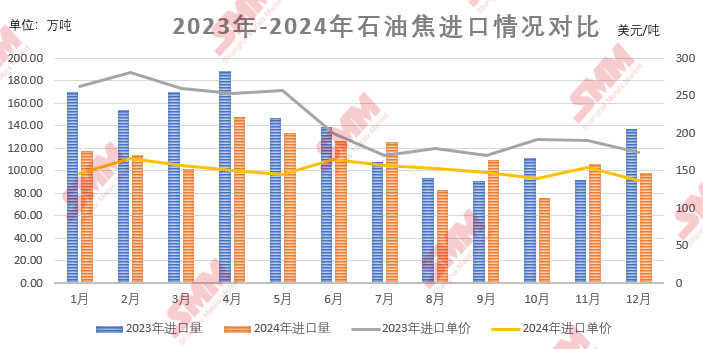
[SMM Analysis: China's Petroleum Coke Imports Significantly Declined in 2024, Market Demand Expected to Recover in 2025] According to customs data, China's petroleum coke imports in December 2024 totaled 982,900 mt, down 7.32% MoM and 28.45% YoY. The estimated import price of petroleum coke in December was $136.84/mt, down 11.57% MoM and 21.67% YoY. In 2024, China's total petroleum coke imports amounted to approximately 13.4 million mt, down 16.35% YoY.

SMM, January 24:

According to customs data, China imported 982,900 mt of petroleum coke in December 2024, down 7.32% MoM and 28.45% YoY. The estimated import price of petroleum coke in December was $136.84/mt, down 11.57% MoM and 21.67% YoY. In 2024, China's total petroleum coke imports amounted to approximately 13.3988 million mt, down 16.35% YoY.


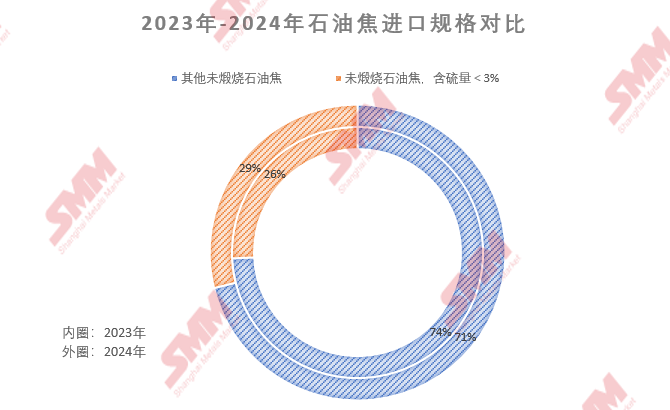
By import type, in 2024, the ratio of sulfur content <3% to other uncalcined petroleum coke was approximately 3:7. The import volume of "uncalcined petroleum coke with sulfur content <3%" reached 3.8658 million mt, down 6.23% YoY, while the import volume of "other uncalcined petroleum coke" reached 9.533 million mt, down 19.86% YoY.


By import country, in 2024, China's main sources of petroleum coke imports were the US, Russia, and Saudi Arabia, with import volumes (import shares) of 3.8614 million mt (29%), 2.4719 million mt (18%), and 1.5548 million mt (12%), respectively.
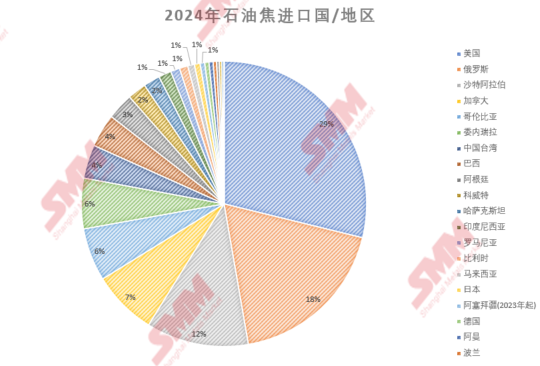
 

In 2024, the overall import volume of petroleum coke significantly declined, especially in Q1, when weak downstream demand led to a YoY decrease of 32.49%. However, in Q2, domestic refineries entered the maintenance season, reducing resource supply. Coupled with the recovery of the downstream anode material market and the rigid demand for carbon used in aluminum production, domestic market demand increased significantly, leading to a rebound in petroleum coke imports. By year-end 2024, petroleum coke inventories at domestic ports continued to decline, particularly in Q4, when a rapid destocking phase occurred. This inventory reduction reflects a recovery in market demand for petroleum coke. Looking ahead to 2025, downstream orders from anode material enterprises are performing well, and companies are actively procuring petroleum coke. Additionally, the rigid demand in the carbon market and frequent shutdowns for maintenance at domestic refineries, which result in tight supply, are expected to drive an upward trend in petroleum coke imports.
Data Source Statement: Except for publicly available information, all other data are processed by SMM based on publicly available information, market communication, and relying on SMM's internal database model. They are for reference only and do not constitute decision-making recommendations.

For any inquiries or for more information, please contact: lemonzhao@smm.cn
For more information on how to access our research reports, please contact:service.en@smm.cn
Related News
Central China Aluminum Market Sees Sluggish Trading and Falling Prices Post-Mid-Autumn Festival
27 mins ago
Central China Aluminum Market Sees Sluggish Trading and Falling Prices Post-Mid-Autumn Festival
Read More
Central China Aluminum Market Sees Sluggish Trading and Falling Prices Post-Mid-Autumn Festival
On the first trading day after the Mid-Autumn Festival, downstream processing enterprises in the central China market showed limited stockpiling sentiment, and stockpiling for the National Day holiday had largely concluded. Although SHFE aluminum futures edged lower again, overall trading activity in the market remained sluggish. Suppliers leaned toward selling quickly to clear inventory, with little inclination to hold prices firm, and transaction prices continued to decline. Ultimately, actual transaction prices in the central China market were around a discount of 20-70 yuan/mt against the SHFE aluminum October contract.
27 mins ago
Laos and Vietnam Discuss $1B Dakcheung Bauxite Project, Focusing on Eco-Impacts and Community Livelihood
37 mins ago
Laos and Vietnam Discuss $1B Dakcheung Bauxite Project, Focusing on Eco-Impacts and Community Livelihood
Read More
Laos and Vietnam Discuss $1B Dakcheung Bauxite Project, Focusing on Eco-Impacts and Community Livelihood
A special seminar on the Dakcheung bauxite and alumina integrated project in Xekong Province was recently held in Vientiane, Laos. Officials from Laos and Vietnam attended the meeting together with the project development team, conducting in-depth discussions on core topics such as standardized project operation and management, production technical specifications, and local workforce placement, with a particular focus on assessing the ecological and environmental risks and community livelihood impacts after the project is put into operation. The Dakcheung bauxite integrated project is the largest mining investment project Vietnam has deployed in Laos, with a total investment of $1 billion. Once the first phase is completed and put into operation, alumina production is expected to reach 1 million mt per year, with formal commissioning planned for 2028.
37 mins ago
Inner Mongolia and Xinjiang Firms to Invest $1B in Kazakhstan's Green Aluminum Smelter Project
42 mins ago
Inner Mongolia and Xinjiang Firms to Invest $1B in Kazakhstan's Green Aluminum Smelter Project
Read More
Inner Mongolia and Xinjiang Firms to Invest $1B in Kazakhstan's Green Aluminum Smelter Project
Inner Mongolia Wanjiang Investment Group, together with Xinjiang Sanbao Industrial Group, signed a cooperation framework agreement with the Abai Region of Kazakhstan to jointly advance the implementation of a large-scale green electricity aluminum smelter construction project. The total investment of the project is $1 billion, with a designed annual capacity of 300,000 mt. It will be supported by a 1GW large-scale wind farm to ensure clean energy supply for aluminum production throughout the entire process. According to the construction plan, the aluminum smelter is expected to start construction in March 2027 and be fully completed and put into operation in December 2028. Once completed, it will effectively fill the capacity gap for high-end aluminum products in Kazakhstan.
42 mins ago